
Bought $AZO last week.
Autozone was at 38% drawdown in 2017 when price reached 550. Now shares are trading at 2,871, which is a 52-week low and in a 34% drawdown from ATH. Despite the current drawdown, those who bought in 2017 are pocketing a commanding 20% annual price return ((2,871/550)^(1/9) – 1). S&P delivered around 15% during the same period.
That is about the past though, and I am not buying because of the past. An intelligent investor should base their decisions on the future. Finding out what lies ahead is the most complicated part because we never can predict the future and even if we can come up with a reasonable estimate, it is often already reflected in the price we pay.
Past
So what is happening with this wide-moat autoparts retailer? Let’s start from the basics.
We know that growth and ROIC drive value. Companies with high growth and improving ROIC are delivering market-beating returns. AZO is no different.
Looking at these two indicators, there are valid reasons for the stock’s decline. ROIC and margins have been under pressure since 2023:
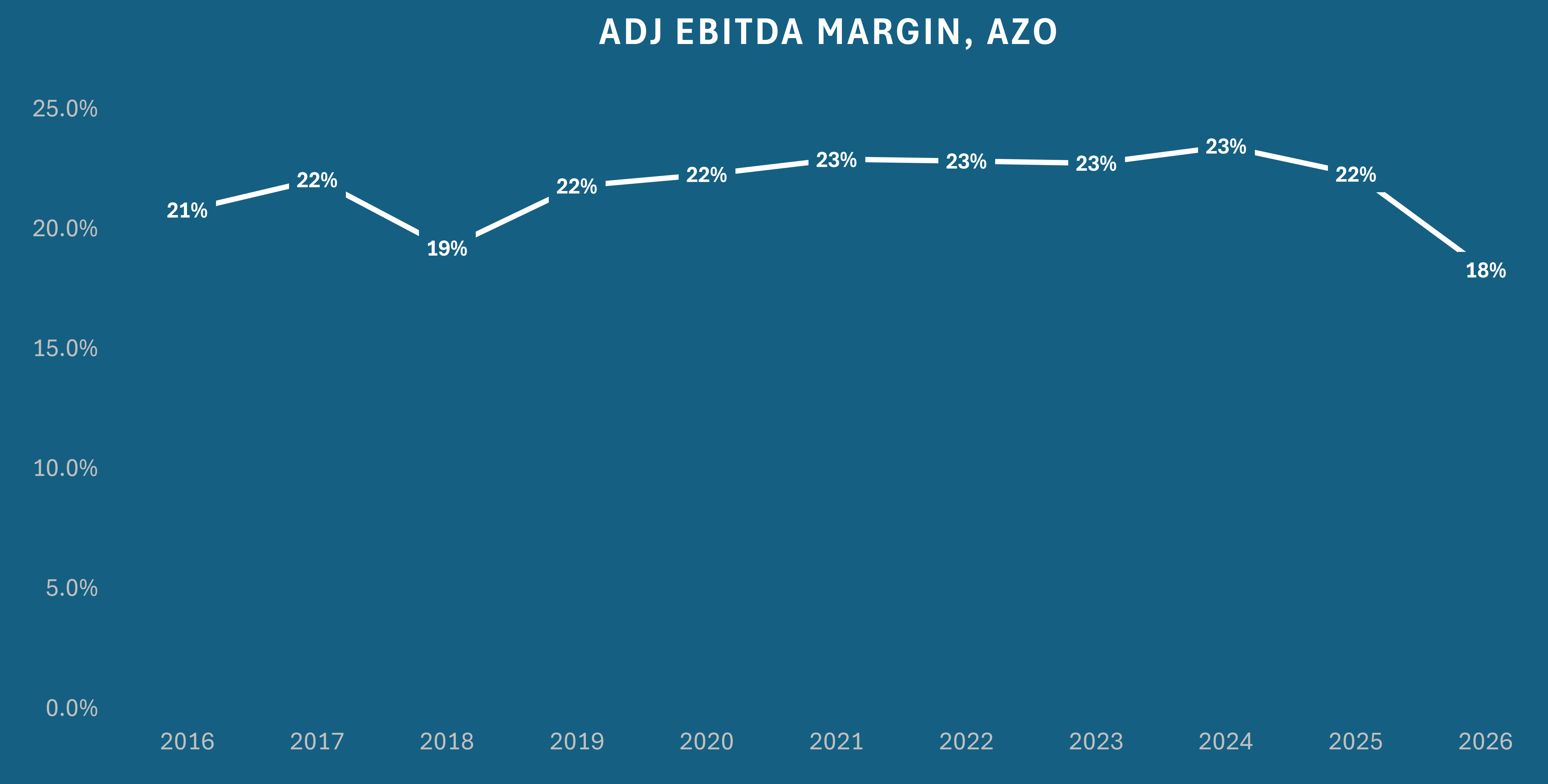
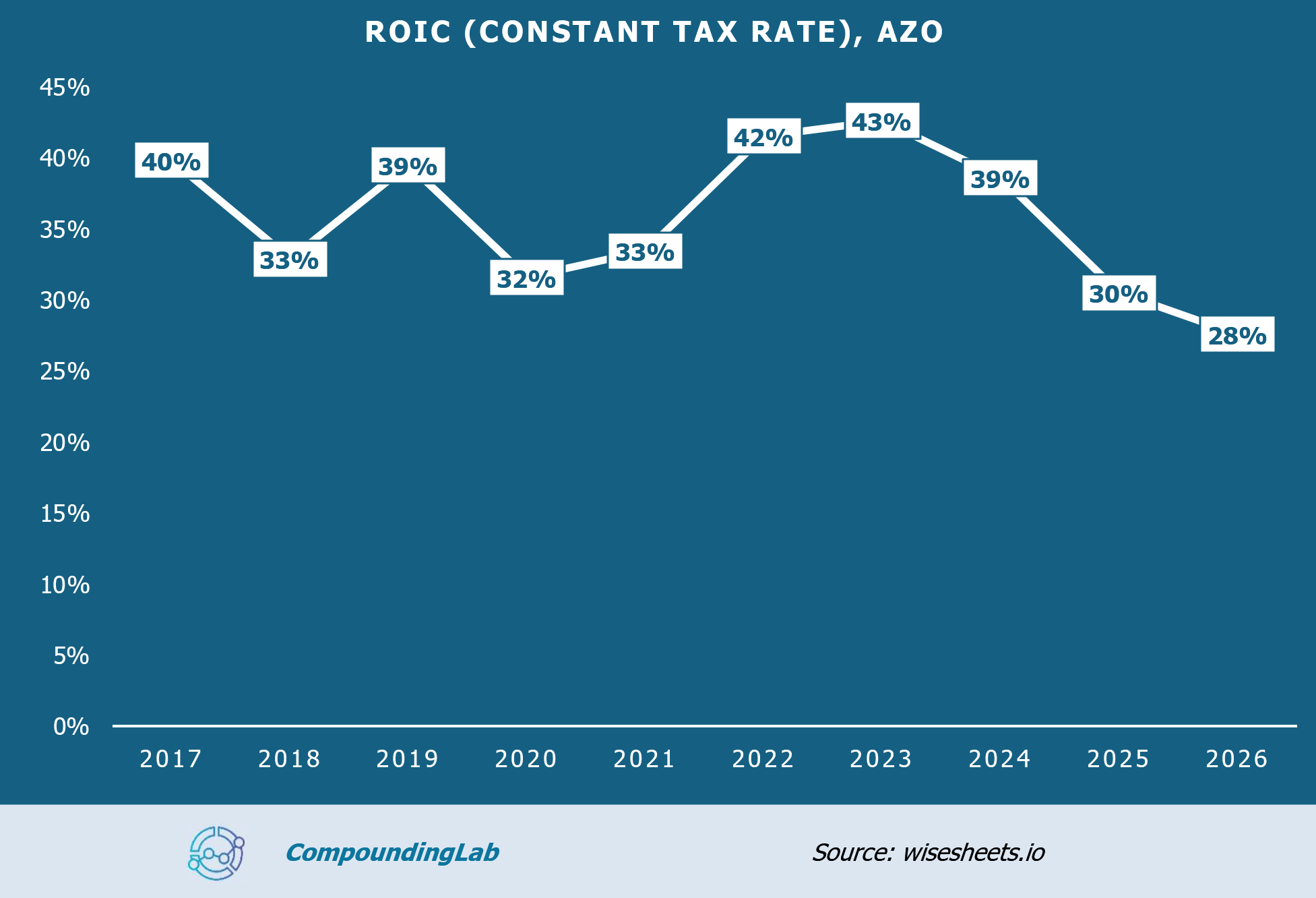
In my view, AutoZone’s recent ROIC decline looks much less worrying than the headline suggests. The biggest reason for decline is that invested capital has increased sharply while operating profit has been roughly flat. There was no major deterioration in the underlying business although after reading 2026 report there are some areas of concern.
NOPAT 3,045M 2026 vs NOPAT 2,974M 2025
Average Invested Capital 10,877M 2026 vs Invested Capital 9,538M 2025
ROIC 28% vs 31% (or 28% vs 30% at constant tax rate)
NOPAT grew only 2.4%, far below the growth in invested capital, making the denominator largely responsible for the ROIC decline. AutoZone is presently putting capital into stores, distribution capacity, inventory availability and commercial-growth initiatives faster than those investments are producing operating profit. Here is a detailed breakdown of what is happening.
1. Record store openings with a slow return ramp (the main driver). AutoZone opened 374 stores in fiscal 2026, the heaviest rollout in its history, with 400 planned for 2027. This pace pushed SG&A up 8%. With an average investment of around USD 2.9M per store, management assumes ROIC is roughly zero in the first year, about 15% by the end of year four, and over 20% by the end of year six. Every new cohort lowers blended ROIC until it matures.
2. Mega Hub, supply chain, and IT buildout continues. AutoZone opened 39 Mega Hubs during fiscal 2026, ending the year with 172, and is targeting about 300 over the next three years. International distribution centers are also being built: Monterrey is complete and León has broken ground. All of this adds up-front capital before incremental sales show up. Free cash flow was nevertheless roughly flat at 1.8B, despite a 169M increase in capex.
3. Inventory growth and weaker payables leverage. This is the less obvious driver, and it matters because AZO’s historically negative working capital is a big part of why its ROIC was so high. Inventory rose 10.1%, inventory turns eased to 1.3x, and accounts payable to inventory fell to 111.1%. Earlier in the year the erosion was clearer: net inventory per store was negative $105 thousand versus negative $161 thousand the year before. Less vendor financing means more of AZO’s own capital sits in inventory.
4. Numerator drag from LIFO. For the full year, gross margin was hurt by a 61 basis point non-cash LIFO charge, partly offset by a 48 basis point benefit from tariff refunds.
5. The big issue for me is that DIY comps were down 0.6%. On 22 September earnings call, management said DIY average ticket was up roughly 5%, but this was more than offset by lower transaction volumes/traffic. They cited milder weather earlier in the quarter, higher inflation pressure on consumers, and some evidence of repair deferral/trading down among financially stretched DIY customers. Commercial was strong enough to keep overall domestic comps positive despite weak DIY. For the long term, it is a worrying signal, because commercial carries a lower gross margin than DIY. AutoZone can have positive same-store sales while margins still face pressure if commercial is becoming a larger share of the business. Management said DIY trends improved toward the end of the quarter, being roughly flat in August.
To conclude, AutoZone was still spending heavily on stores, distribution, IT and commercial growth while sales leverage weakened in Q4. Margin pressure was not caused by a full-year sales collapse, but slower late-year comps made it harder to absorb the elevated expense base.
Growth
So growth is clearly still there, with revenue 10Y CAGR being up 7%, and EPS up 14%. FY2026 showed decent same-store sales year overall. Domestic comps grew at 3.3% versus 3.2% in FY2025. However, momentum deteriorated sharply late in the year, with Q4 domestic comps falling from 4.8% to 1.6%.
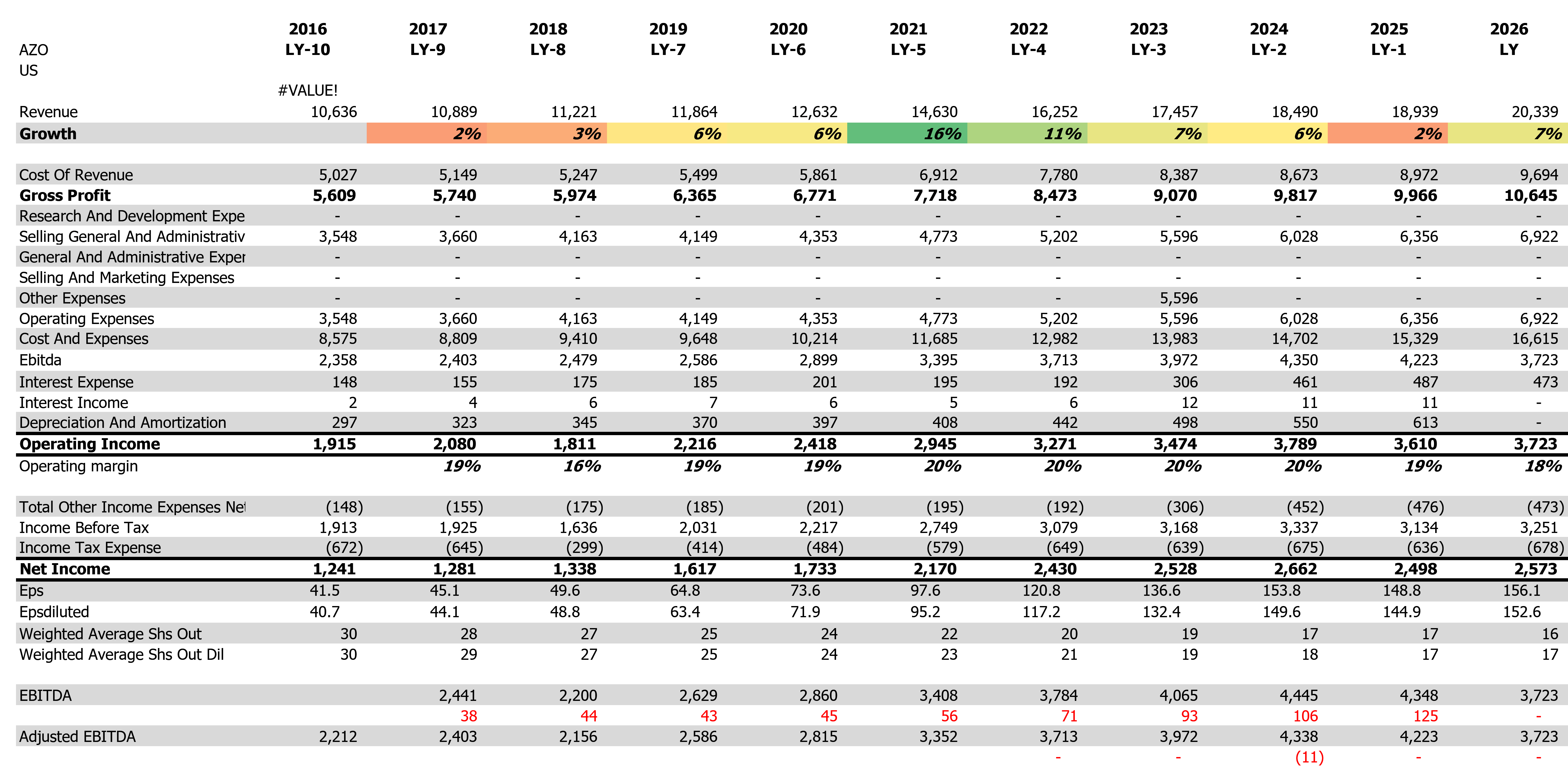
Not surprisingly, price returns were poor recently – this is expected based on our knowledge that ROIC and growth drive value.

Future
ROIC
ROIC trend is falling while comparable-store sales are essentially flat, and this reinforces the point that the decline looks more like a capital-intensity/investment-cycle issue than deterioration in store economics.
28%-30% ROIC over the next 15 years is a reasonable long-term estimate.
Growth
There are 23 analysts covering AZO. On average, they believe shares are undervalued by around 25%. However, only 2 analysts provide an EPS growth forecast, and they believe that the company can achieve 14% earnings growth for the next 3-5 years.
For my 15Y forecast I am going to use a more conservative figure of 10% interpreted as follows:
Revenue growth 5% + margin/operating leverage 1% + buybacks 4% -> EPS growth 10%.
Putting all together
My favorite framework for quickly evaluating a stock’s attractiveness is Mauboussin’s expected P/E across different ROIC and growth scenarios.
The key question is whether this is a J-curve or a structural decline. The case for a J-curve rests on the new-store maturation data and mid-double-digit sales uplift in commercial programs linked to Mega Hubs. The main thing to watch against it is the AP-to-inventory ratio, because if the negative working capital advantage doesn’t come back, part of the ROIC drop is permanent. DIY same-store sales is also an important KPI to watch.
Having considered all of this, I believe the most reasonable expectation we can build is for ROIC to be around 28% within the next 15 years (too far, I know, but here we are. The market has no choice but to guess). For EPS growth, I will be using 10%. Plotting these two together, I came up with a 26.6 PE versus today’s 19, meaning that shares are undervalued by 28% (or 40% probable alpha). Here we need to be careful, though, because AutoZone never had such a high PE over the last 10 years, which makes me think the market has discounted it along the way and is likely to continue discounting it relative to its intrinsic value. Nevertheless, I do believe that a more realistic P/E should be near 23-24, not far from the max PE recorded by AZO in 2025. This will potentially deliver 25% alpha.

Disclaimer: This post is for informational and educational purposes only. I might have bought shares in AZO or can buy/sell them at any time after this post is published. Not financial advice. Do your own research.
Good buy. I will wait for far better prices to increase my potential return.