Crypto mining companies transitioning to HPC/AI (assymetric opportunity)

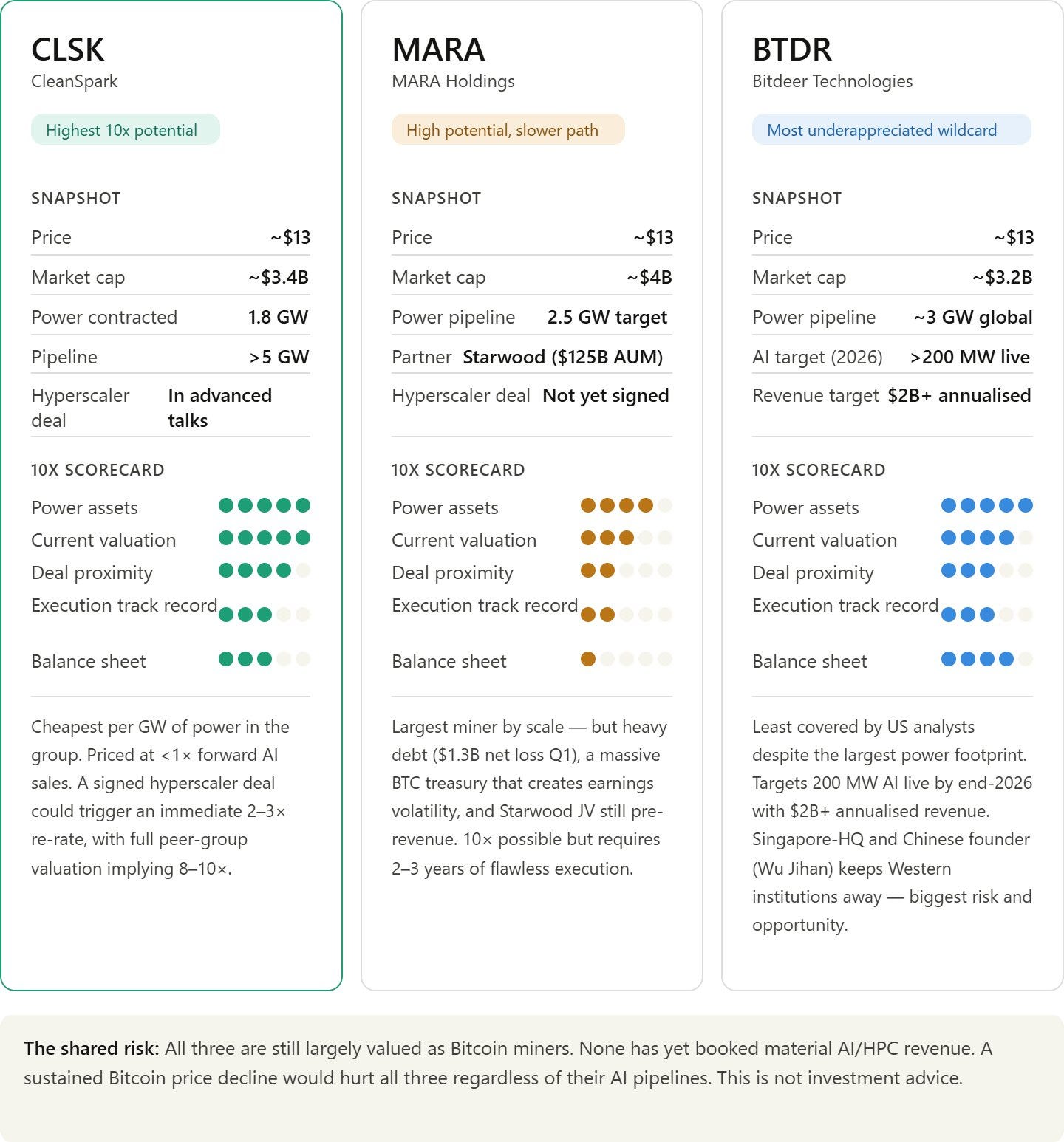
$CLSK
$MARA
$BTDR
Significant deficit of AI data centers is expected within the next decade.
Industry analysts at Sightline Climate confirm that data centers representing 12-16 gigawatts of new power demand were announced for completion in 2026, yet only about one-third have broken ground. Roughly 5 GW are under active construction, which is 30% of what operators committed to deliver this year. The resulting shortfall has become the defining metric of the cycle.
The data center shortfall is forecast to be 9.3 GW in 2026, rising to 10 GW by 2028.
What's causing the bottleneck?
The primary constraint isn't money. It's physical infrastructure, especially power. And CleanSpark, Mara and Bitdeer already have accomplished connections to the grid.
Pre-2020 lead time on a high-power transformer was 24–30 months. Today it stretches to 5 years. Electrical equipment is under 10% of total data center cost and 100% of the bottleneck.
The volatility of exports from China compounds this, as China accounts for over 40% of U.S. battery imports, while its share in certain transformer and switchgear categories remains near 30%.
A modern AI data center can be deployed in under 18 months when all components are available. But the power infrastructure required to feed it can take up to five years to build.
Even if all currently known plans are delivered on time, there could still be a data center supply deficit of more than 15 GW in the United States alone by 2030.
Demand for AI-ready capacity is the main driver of this potential deficit, and is expected to rise at an average rate of 33% per year between 2023 and 2030 according to McKinsey.
All those factors lead to ripple effects.
AI data center construction has driven memory costs up five-fold and storage costs up three-fold since Q1 2025, crowding out consumer electronics categories like smartphones, PCs, and gaming consoles.
Companies are of course adapting. About 30% of anticipated data center energy capacity is now expected to come from on-site generation sources, up from effectively zero just a year ago => hyperscalers pursue direct generation partnerships to bypass congested grid infrastructure.
In short: capital is abundant, but physical constraints such as transformers, grid capacity, land, and cooling mean that even hundreds of billions in investment can't simply conjure new capacity quickly enough to meet demand.
I already have Mara in my portfolio.
Buying on Monday another 2.
Re-rating is inevitable once management fully realizes the benefits of conversion to AI/HPC. I hope they move fast.