$ORCL DCF valuation model

Today Oracle is down another -4% and is currently in a 56% drawdown, the largest since the Great Financial Crisis. A reasonable step for a knowledgeable investor will be to examine its intrinsic value. Without further ado, let’s dig into what lies ahead for Oracle.
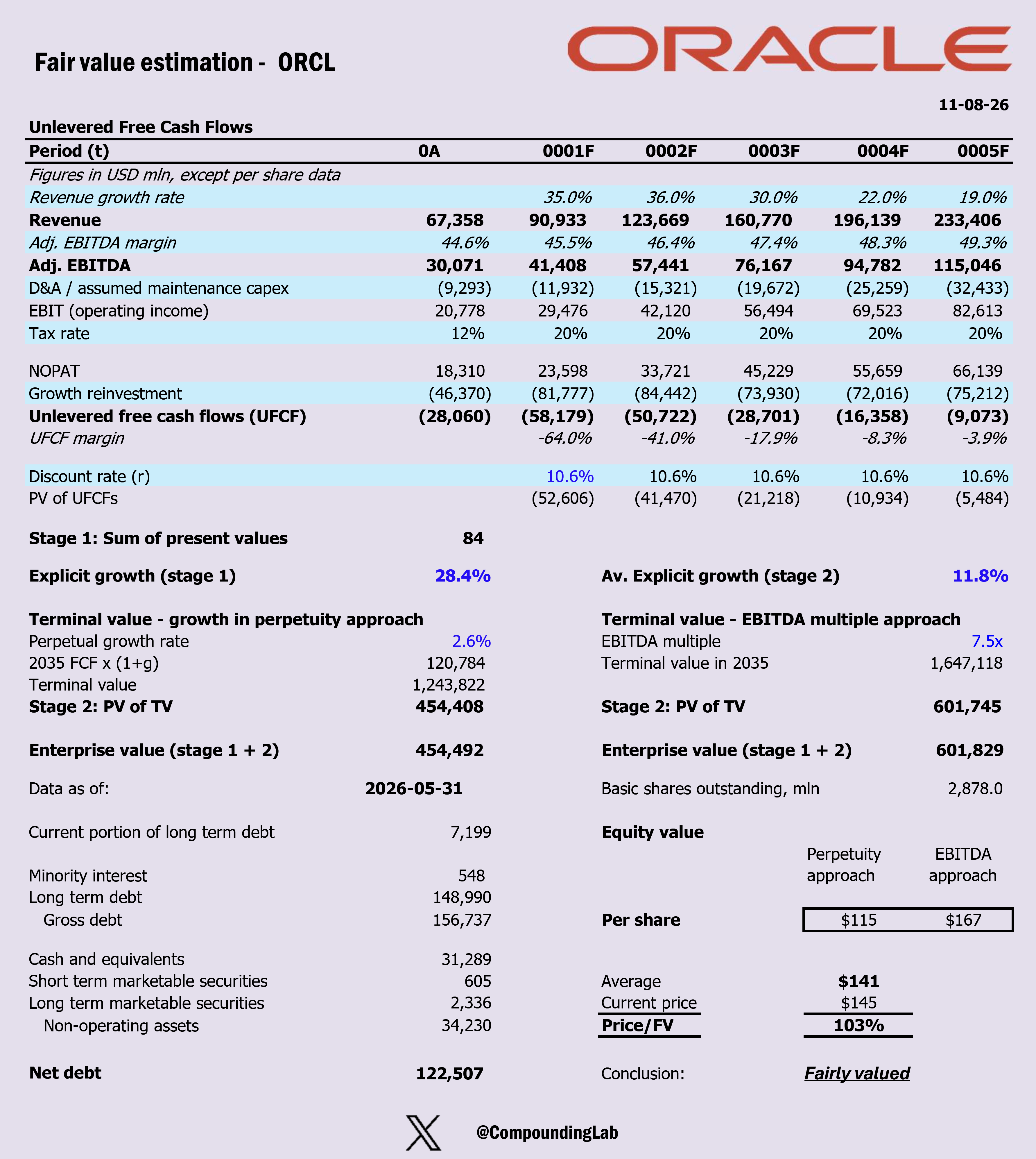
Key assumptions:
Explicit average 5Y/5Y growth @ 28.4%/11.8%
Long-term growth in perpetuity @ 2.6%
EBITDA Margin 45%, improving gradually
WACC @ 10.6%.
Adj. EBITDA exit multiple of 7.5
Tax rate 20% - marginal forward rate
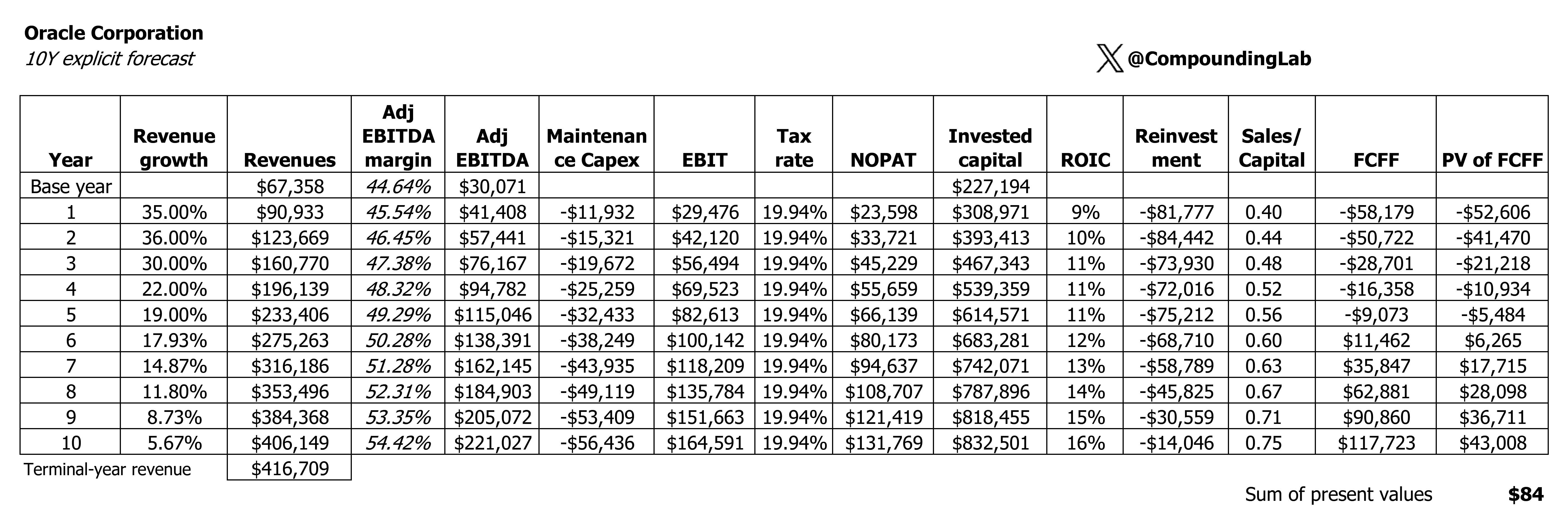
The input that drives reinvestment is the most recent Sales to Capital ratio = 0.4, linearly regressed to the Software (System & Application) average rate of 0.75 in year 10.
Growth profile (for context)
Oracle’s revenue growth is expected to accelerate sharply because of OCI and AI infrastructure contracts.
Management previously projected revenue of $85B in FY2027, $130B in FY2028, $185B in FY2029 and $225B in FY2030. That is about a 31% CAGR from FY2025 and assumes enormous data-center construction, continued financing availability, and successful conversion of unusually concentrated AI contracts into revenue. For DCF model, treating the full $225 billion FY2030 target as the base case would be too optimistic. Therefore, I forecast the same revenue amount, but a year later, in 2031.
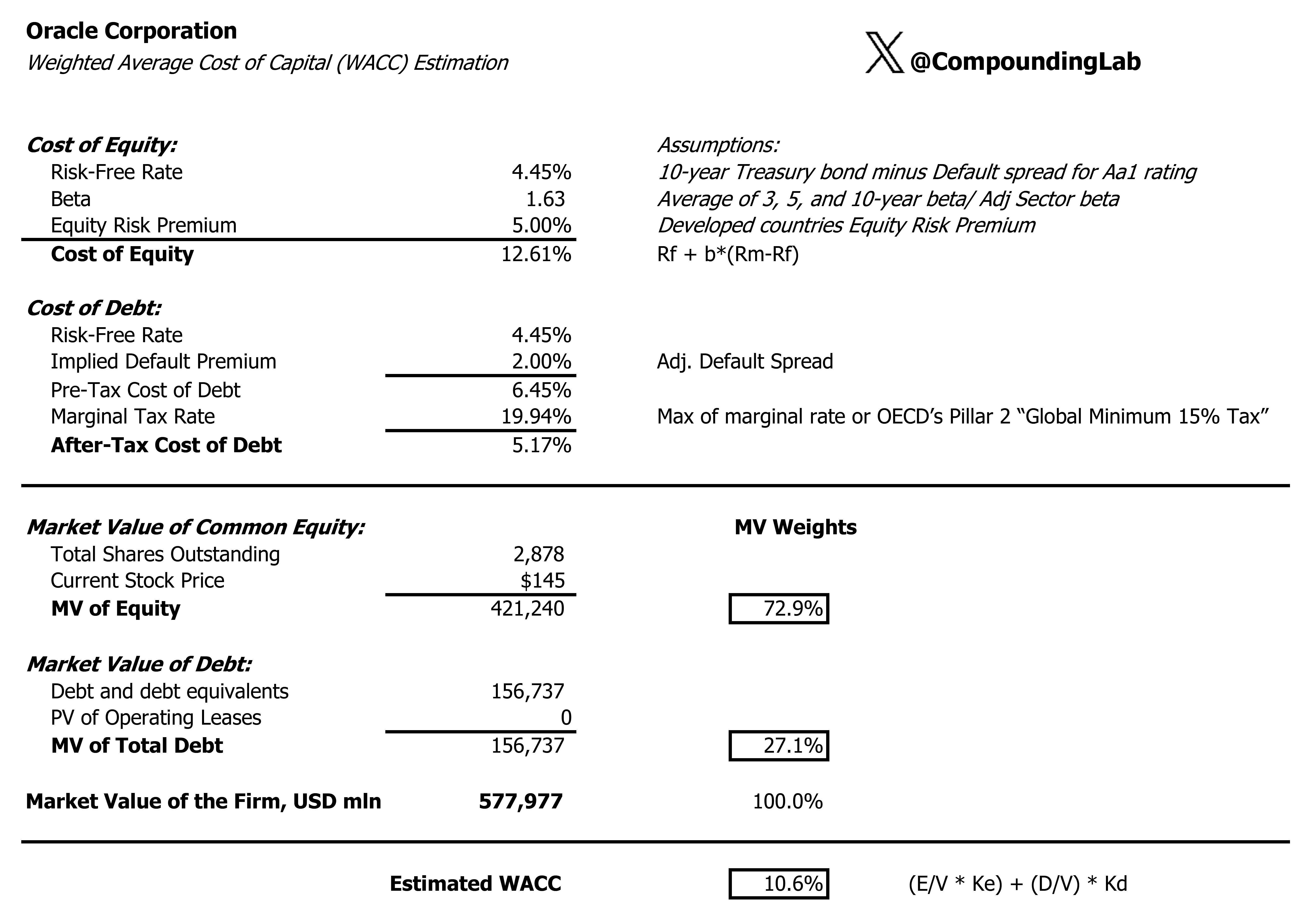
One important note – debt/equity @ 3.5 suggests that the company is deliberately using substantial debt to finance its accelerated AI/cloud infrastructure expansion. This naturally makes investment riskier. That is why when calculating WACC, I am using higher-end beta and 2% implied default premium (credit-default swaps traded near 200 basis points on 29 July 2026).
Verdict
CL intrinsic value for Oracle is 141 USD, which is close to market price 145$. Given that this is highly indebted narrow-moat stock, entry is not justified in my view. Another important caveat here - Enterprise value is ~100% terminal value which is unusual and means that there is a lot of uncertainty surrounding this stock.