$RHM valuation
Once forbidden from producing weapons, Rheinmetall has become one of Europe’s most important defense companies. The comeback is remarkable, but the valuation may be even more exciting.

Get a cup of coffee ☕.
In this post, I’ll walk you through Rheinmetall’s intrinsic valuation and the company’s business story.
RHM’s main listing is on the XETRA stock exchange in Germany. Its stock price increased 13-fold over the past five years, which is very rare performance for a defense stock. This impressive return was primarily driven by the Russian invasion of Ukraine and NATO’s increased military spending plans. Return can be broken down further into P/E multiple expansion by 4.6x (from 10.5 in 2021 up to 46.68 currently) and an EPS increase of 3x.
Rheinmetall now stands out as a key beneficiary of NATO’s pledge to allocate 3.5% of GDP on core defense by 2035, Germany’s Zeitenwende speech, and continued Ukraine-driven replenishment demand. The company’s influence has grown so significantly that the Russian government reportedly contemplated assassinating CEO Armin Papperger.
The stock is down by 23% year-to-date, and as thoughtful investors, you are eager to see how appealing the current share price is compared to its expected future cash flows. We will find out this together.
Description of business
Rheinmetall AG is a technology group that delivers advanced solutions to both the mobility and security sectors. Its operations are structured into three distinct business units: Vehicle Systems, Weapon/Ammunition and Electronic Solutions. Sensors and Actuators, and Materials and Trade were the two operating segments under Rheinmetall’s former civilian Power Systems division (the old Automotive/Pierburg business), which Rheinmetall has now fully exited to concentrate on defense.
Founded in 1889 and headquartered in Düsseldorf, Germany, the company was initially known as Rheinmetall Berlin AG before adopting its current name, Rheinmetall AG, in 1996.
I have to admit that Rheinmetall’s story and products range deserve a full separate long-format article, but today I want to release this valuation to you as soon as possible. I am genuinely interested and maybe I will dedicate a separate post in the future to cover more about it. RHM history was not always a bright spot.
Now. Let’s explore the valuation.
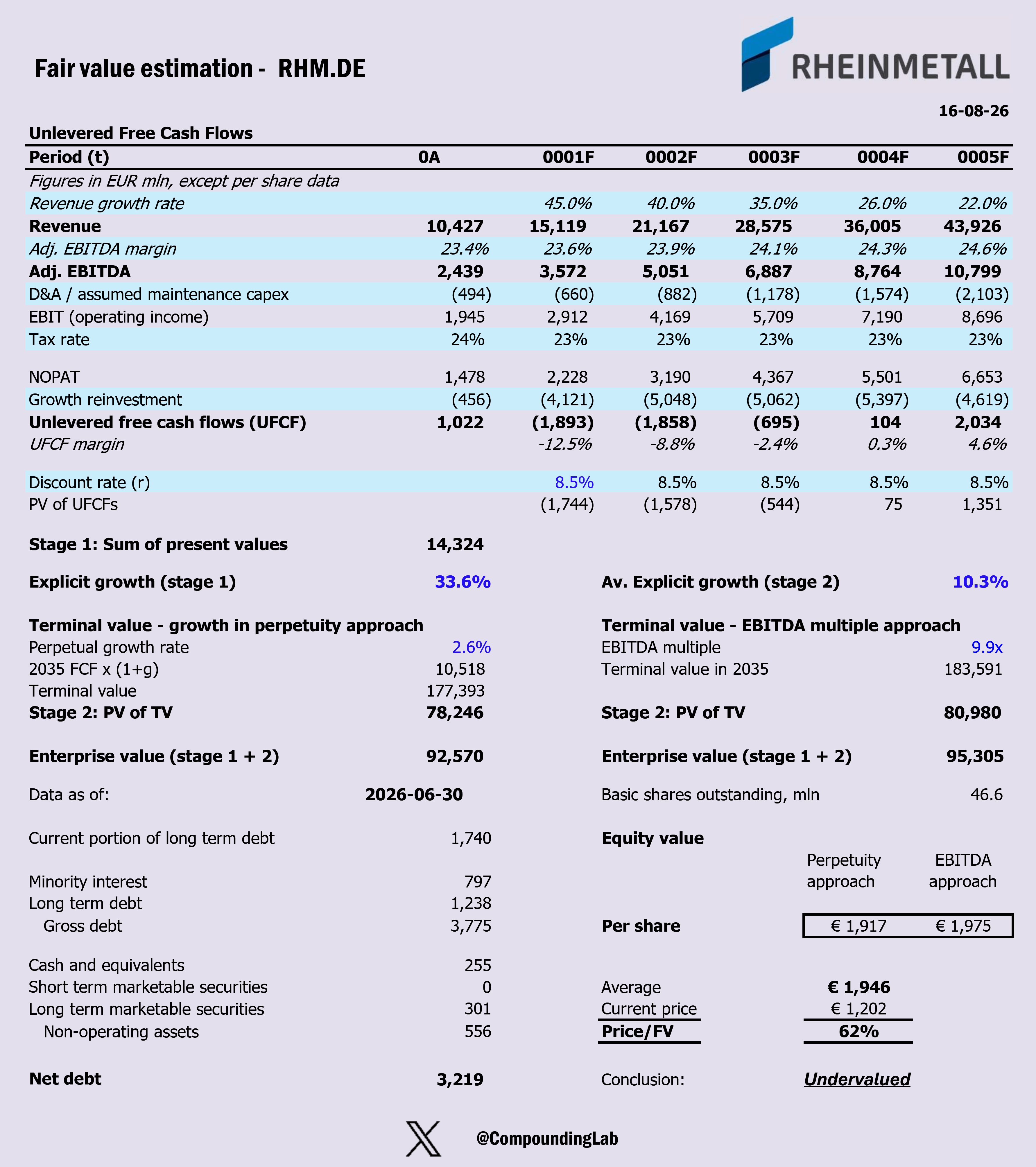
Key assumptions:
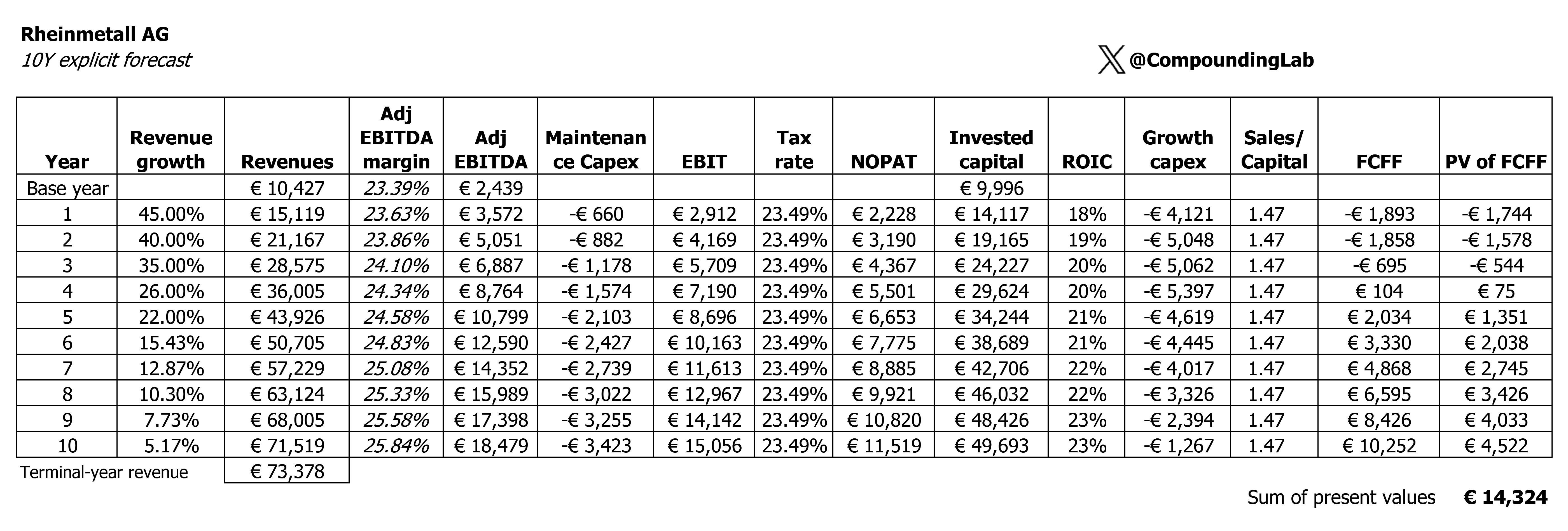
Explicit average 5Y/5Y growth @ 33.6%/18%
Long-term growth in perpetuity @ 2.6%
EBITDA Margin 24-26%
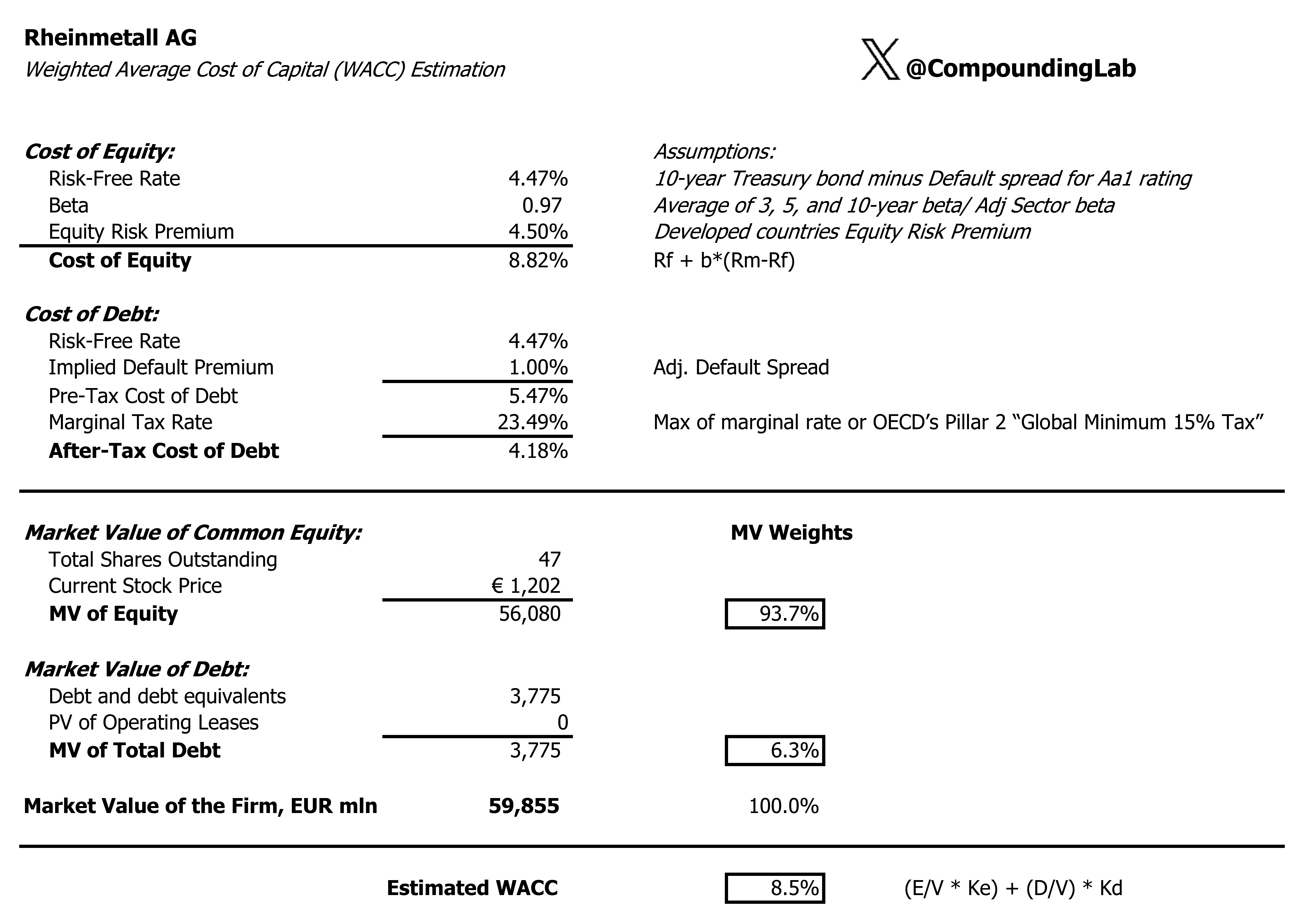
WACC @ 8.5%
Adj. EBITDA exit multiple of 9.9
Tax rate 23% - in line with historical average
The input that drives reinvestment is the most recent Sales to Capital ratio = 1.47
Growth profile (for context)
Group revenue is reported by division rather than individual product. Based on FY2025 results, group sales hit a record €9.94 billion, up sharply from 2024, split across three divisions.
Vehicle Systems is the largest, at €4,992 million (+32% YoY). This is the armored vehicle business and includes products such as Boxer wheeled armored vehicles, Leopard 2 A8 battle tanks, HX2 military trucks, and swap-body logistics vehicles. Boxer in particular has become the volume driver as multiple NATO members ramp up orders.
Weapon and Ammunition comes next at €3,532 million (+27% YoY), and it’s actually the most profitable division by a wide margin (29% operating margin vs. 11.7% for Vehicle Systems). This segment covers artillery and tank ammunition, weapon systems, and propellants for which demand pulled hard by Germany, NATO restocking, Ukraine, and a large mobile-rescue-station framework deal, plus Nordic orders from Denmark, Finland, Norway and Sweden.
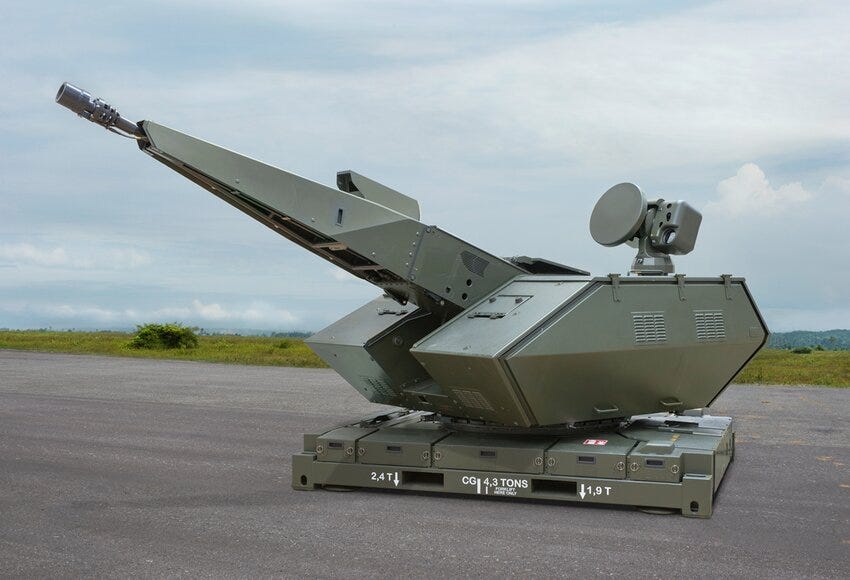
Electronic Solutions is smallest but fastest-growing at €2,504 million (+45% YoY), covering air defence systems (Skyranger and Skynex), digitisation programs like TaWAN for the German army, soldier systems (IdZ-ES), and electronics/sensors more broadly. Note this division is being split into separate Digital Systems and Air Defence segments starting in 2026.
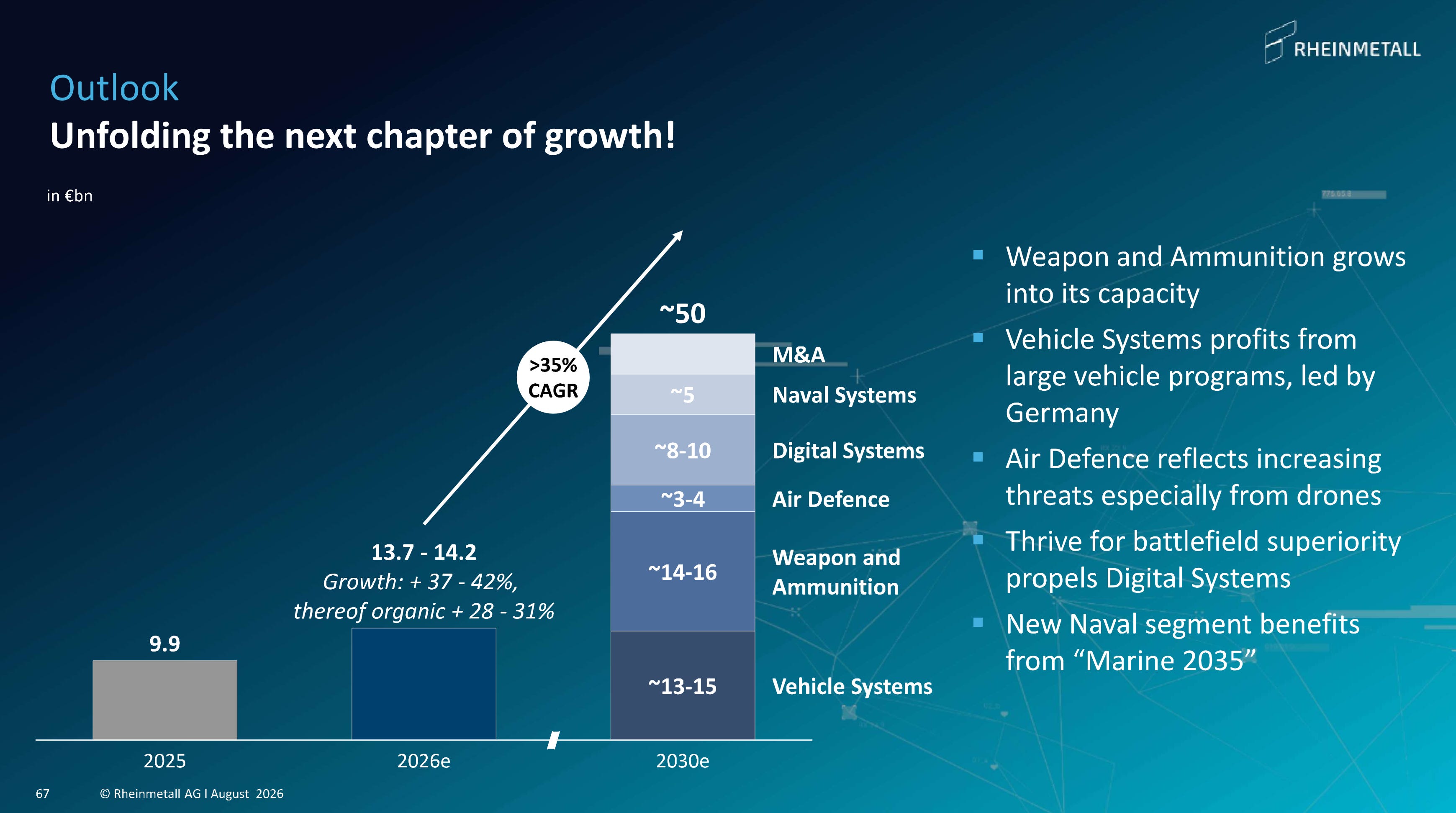
Order backlog hit roughly €73-80 billion by mid-2026, up from €56 billion a year earlier, and CEO Armin Papperger has guided toward quintupling group sales from about €9.8 billion (2024) to €50 billion by 2030. To stay conservative and factor in management bias, in my DCF workings I forecast a lower figure ~44B by mid-2031. This is also in line with analysts’ estimates as cross-checked to CapIQ.
EBITDA margin
My starting point is TTM Adj. EBITDA margin at 23.4%. Historically, the EBITDA margin trend has been on a stable upward trajectory since 2015.
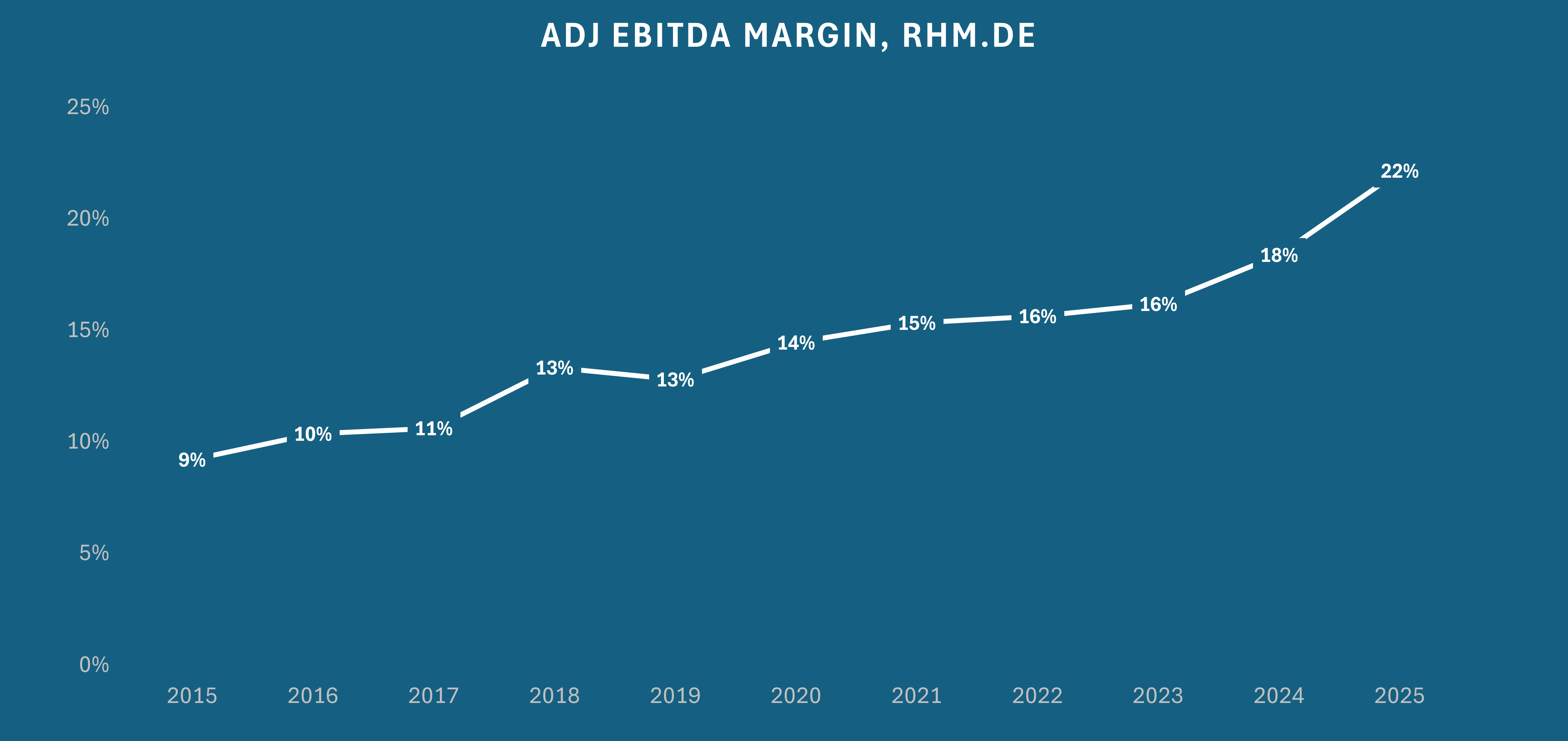
Going forward, I believe it makes sense to factor in the margin-improvement to 26% by Y10. This improvement will be driven by genuine mix-shift into higher-margin Ammunition and Air Defence plus operating leverage on new capacity. The capex/D&A intensity of the current buildout is the main reason I wouldn’t go higher without more visibility on how quickly the new plants season into full utilization.
Moat
Most independent coverage classifies Rheinmetall as wide moat, and the fundamentals back that up. Nevertheless, it’s worth being clear-eyed about what kind of moat it is, because it’s not the classic durable-brand or network-effect kind.
Main moat sources:
Extremely high regulatory, certification and security-clearance barriers.
Decades-long customer relationships with governments and NATO forces.
High switching costs: military platforms remain in service for decades and require compatible ammunition, upgrades and maintenance.
Proprietary technology across ammunition, air defence, armoured vehicles and military electronics.
Efficient scale: enormous investment is required to develop, test and industrialize defense products.
Scarce European production capacity, especially in large-calibre ammunition.
Growing installed base creates recurring ammunition, maintenance and upgrade demand.
The principal weakness is dependence on government budgets and large contract awards. Orders can be delayed or cancelled, as demonstrated by Germany’s F126 decision. Rheinmetall still shows record backlog, meaning that such cancellations did not damage the underlying competitive position so far.
Where the “narrow” argument comes in
The honest caveat is that this moat is largely government-erected rather than product-erected. It’s closer to a regulatory/political moat (like a utility or a gambling licensee) than a patent or brand moat. That matters because it can widen or narrow fast with policy. The entire re-rating since 2022 is a function of NATO Europe rearmament and the Ukraine war; a durable peace settlement or a swing back toward “peace dividend” defense budgets would compress the growth runway, even if the installed-base switching costs stay intact. There’s also customer concentration (government budgets, not diversified private demand) and real execution risk in the capacity ramp. Rheinmetall is pouring capital into new ammunition and vehicle plants, and if book-to-bill normalizes before that capacity is fully absorbed, returns on that invested capital could disappoint. The recently reported approach toward parts of KNDS also signals that consolidation pressure among European primes is still very much live, which is a sign the competitive landscape isn’t fully settled.
For disclosure purposes, I still incorporate a wide moat into my model – this affects the terminal value calculation and can deviate the intrinsic value by +/- 15%.
P/E ratio
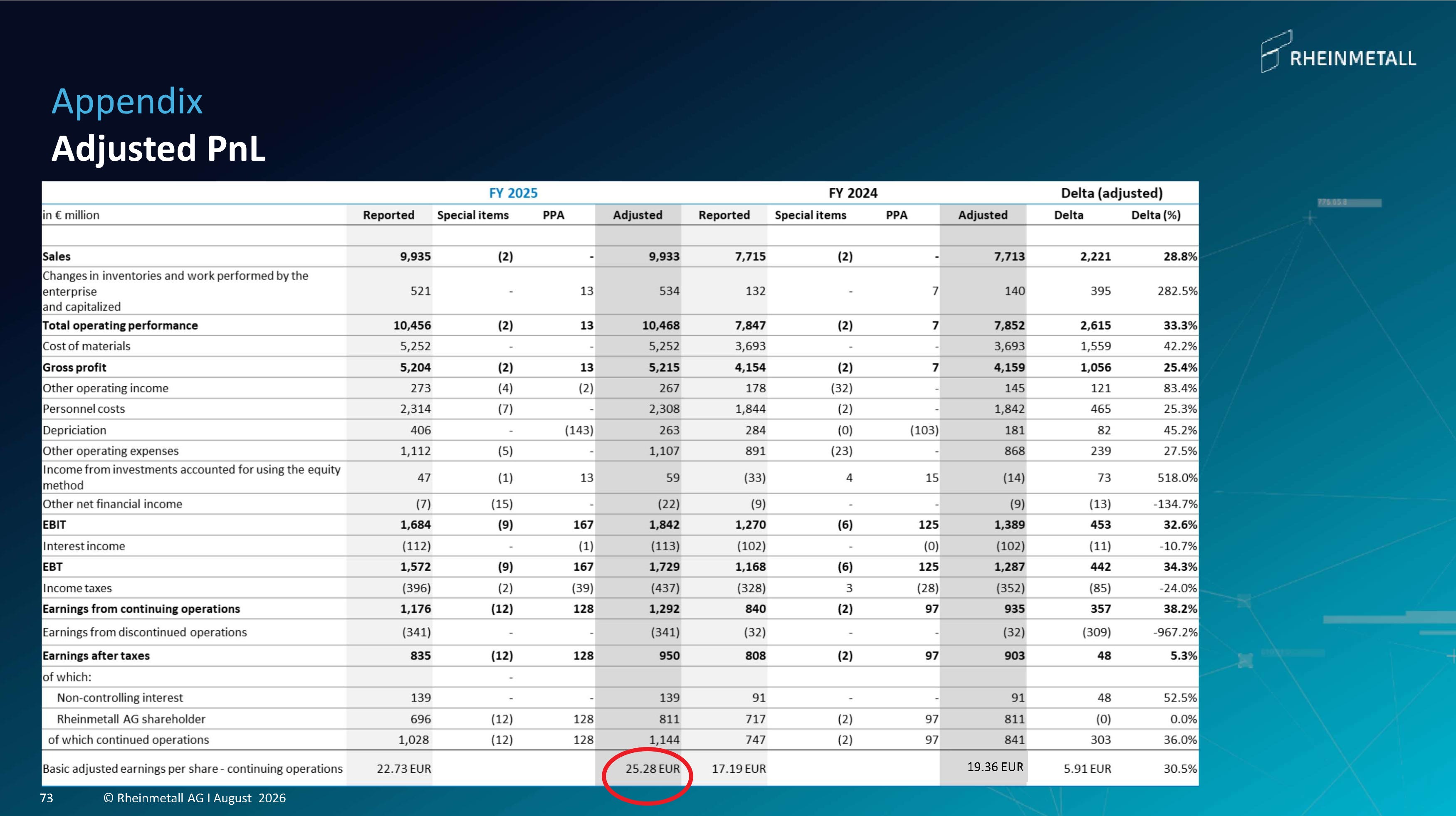
One important observation. When valuing a stock, I normally use Mauboussin’s PE framework to gain a quick idea about attractiveness. If you didn’t have a chance to read about this, have a look. It’s very useful framework which can help to evaluate P/E ratio based on expected ROIC and forward growth. For Rheinmetall, most websites show PE = 47, which is based on reported numbers. To get normalized P/E, this reported ratio needs to be adjusted for the loss from discontinued operations (added back) to get to normalized P/E. On a TTM basis, net income attributable to common shareholders was 887 mln. We need to add back 492 mln of loss on disposal of Sensors and Actuators/Materials and Trade segments. Rheinmetall sold entire civilian division to the investment firm AEQUITA for €350 million in June 2026. The price looked like a striking gap between the €2bn revenue base and the sale price, which drew some market criticism at the time. No matter what, this is a one-off transaction and if added back, the normalized Net Income was 887+492*(1-0.25) = 1,256 mln. To come up with normalized EPS, we need to divide 1,256 mln by number of shares outstanding 46.6mln and use EPS=27 EUR for the purposes of PE calculation. That gives us P/E = 44 (1,200 EUR/27 EUR), slightly lower than reported by data providers. Overall, the P/E level is justified given the company’s growth and ROIC profile.
Do not forget to hit the share button if you enjoy reading this article.
Verdict
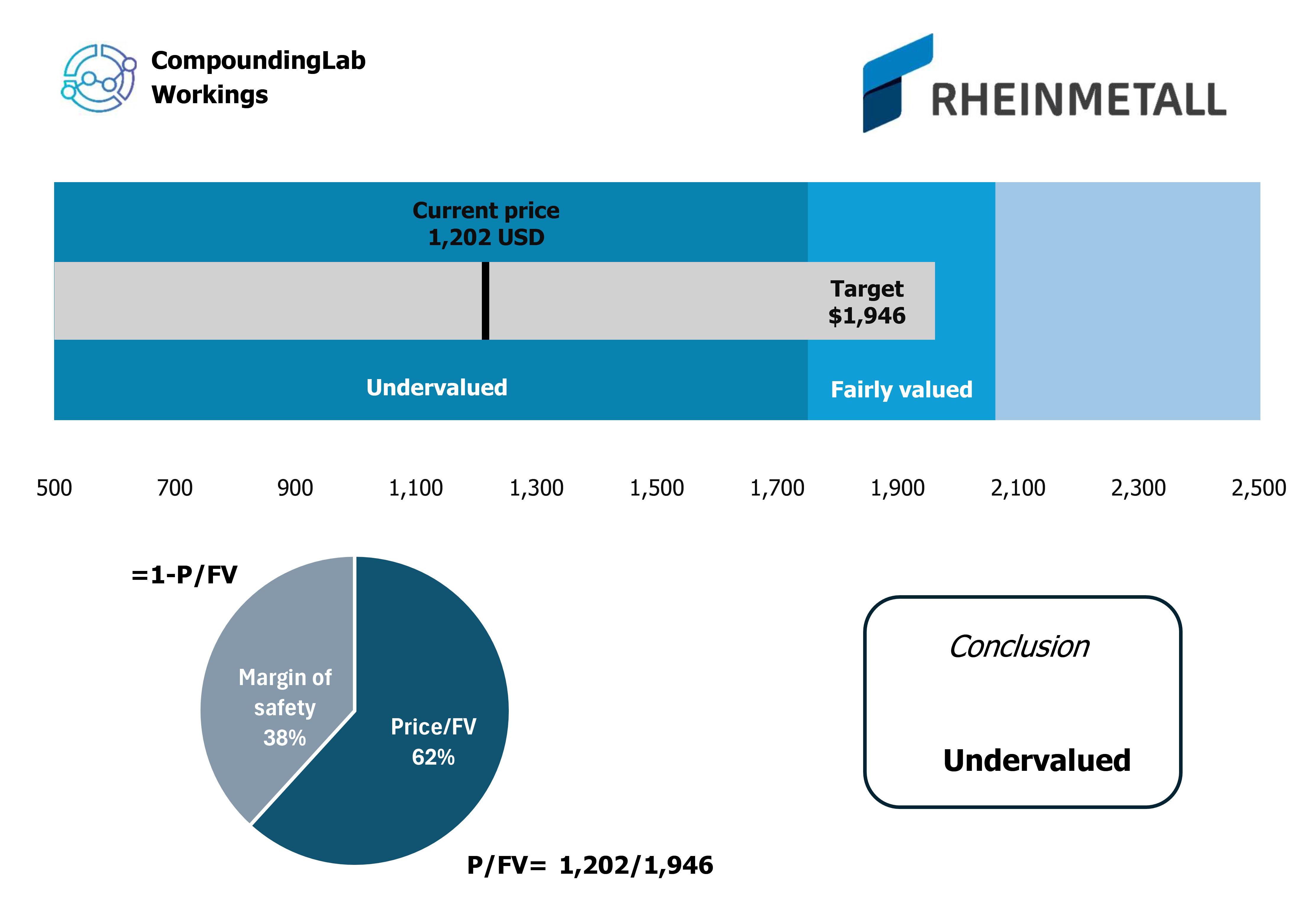
CL intrinsic value for RHM is 1,946 EUR. Valuation suggests that the stock is trading at 38% discount to fair value. If adjusted to FV within 3 years, it will generate an annual alpha @ 17%.
One important outcome worth mentioning: the bulk of the valuation (roughly EUR78.2bn of the EUR92.6bn enterprise value, or about 85%) comes from the value assigned to cash flows after the explicit forecast period. The remaining EUR14.3bn (15%) is the present value of the forecasted cash flows in years 1-10. It means the DCF valuation is highly dependent on assumptions beyond the explicit forecast period. This is important, since any change in model assumptions can change intrinsic value dramatically.
As a refugee with firsthand experience near Russia, it is my deep conviction that companies like Rheinmetall and SAAB will continue to be vital. The Eastern threat to modern democracies remains persistent, and NATO countries are aware of this reality.
Keep in mind that this is an estimate - just like any DCF model. I’m not claiming perfection, but I do trust these calculations to assist with my own investments. Hopefully, they can help inform yours as well. Look at it as a thinking tool, not necessarily as a stock-picking tool.
Disclaimer: This post is for informational and educational purposes only. I do not own shares in RHM and can buy/sell them at any time after this post is published. Not financial advice. Do your own research.