$TSM valuation model

Taiwan’s semiconductor industry represents the strongest security safeguard ever created. Any attacker attempting to compromise it would face substantial risks, with potentially severe and unpredictable repercussions. My goal today is to examine where the company’s figures currently stand.
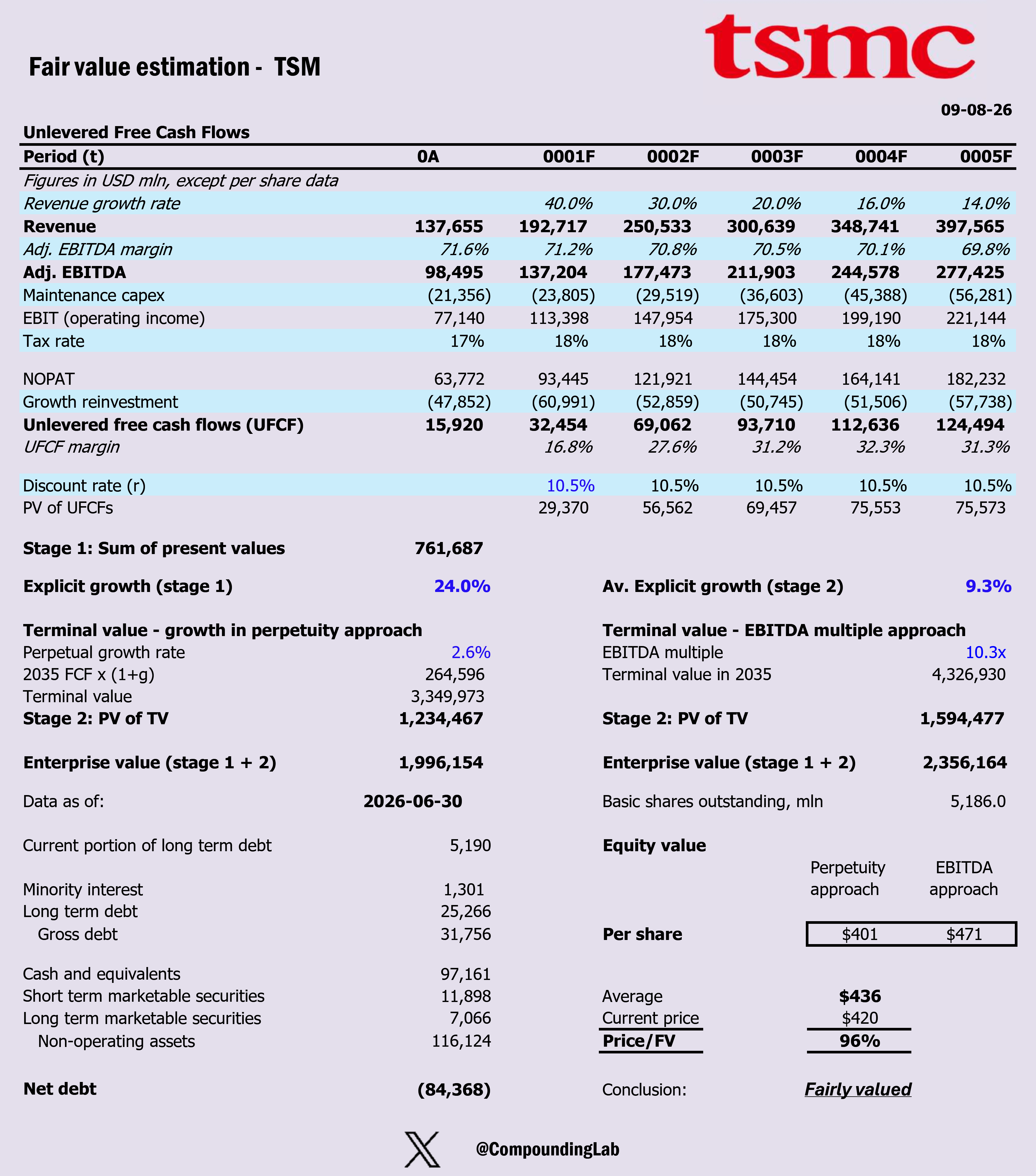
Key assumptions:
Explicit average 5Y/5Y growth @ 24%/9.3%
Long-term growth in perpetuity @ 2.6%
High initial EBITDA Margin, fading gradually to 68% in Y10
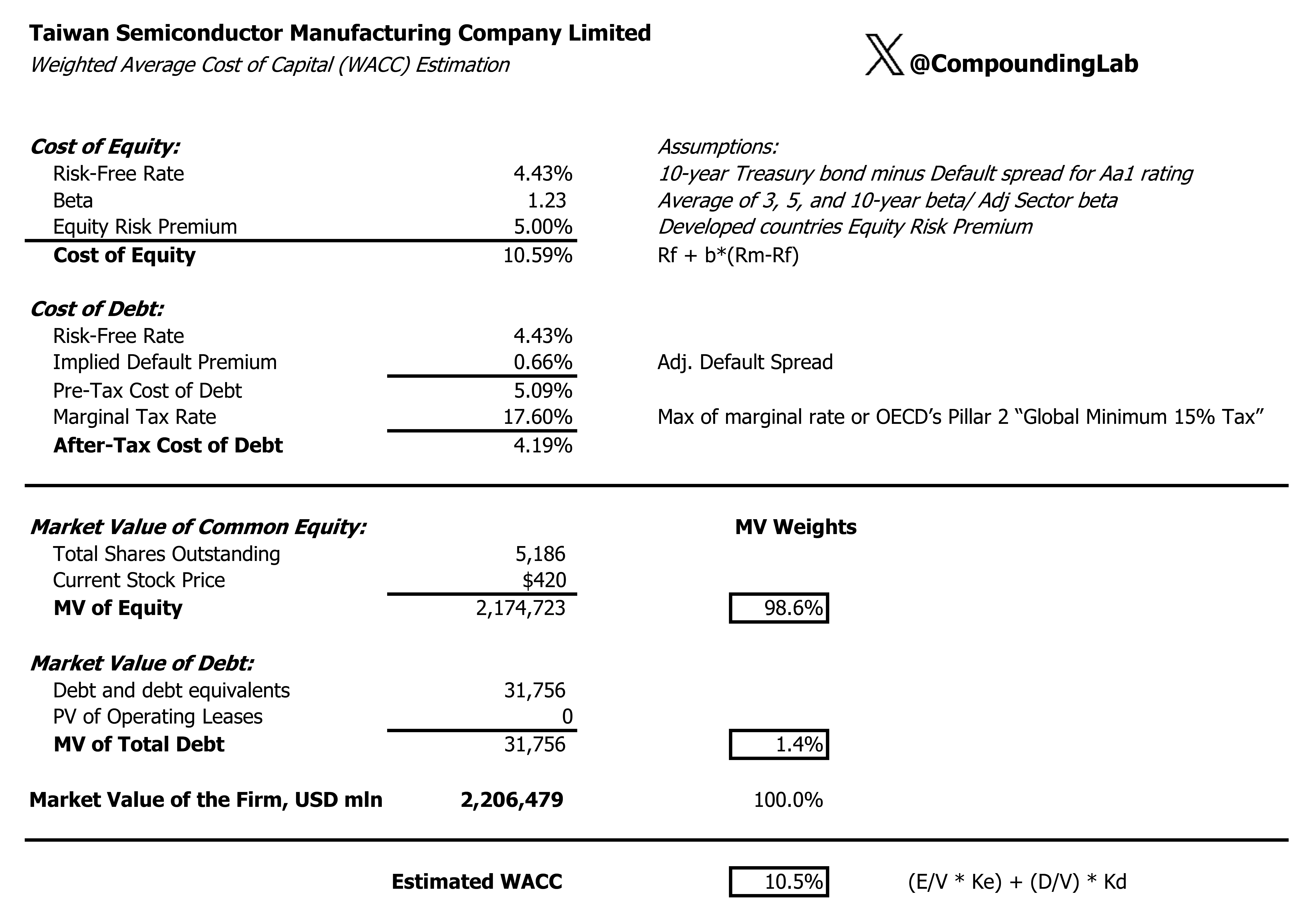
WACC @ 10.5%.
Adj. EBITDA exit multiple of 10.3
Tax rate 18% - company’s historical average
The input that drives reinvestment is forward looking Sales to Capital ratio = 0.95
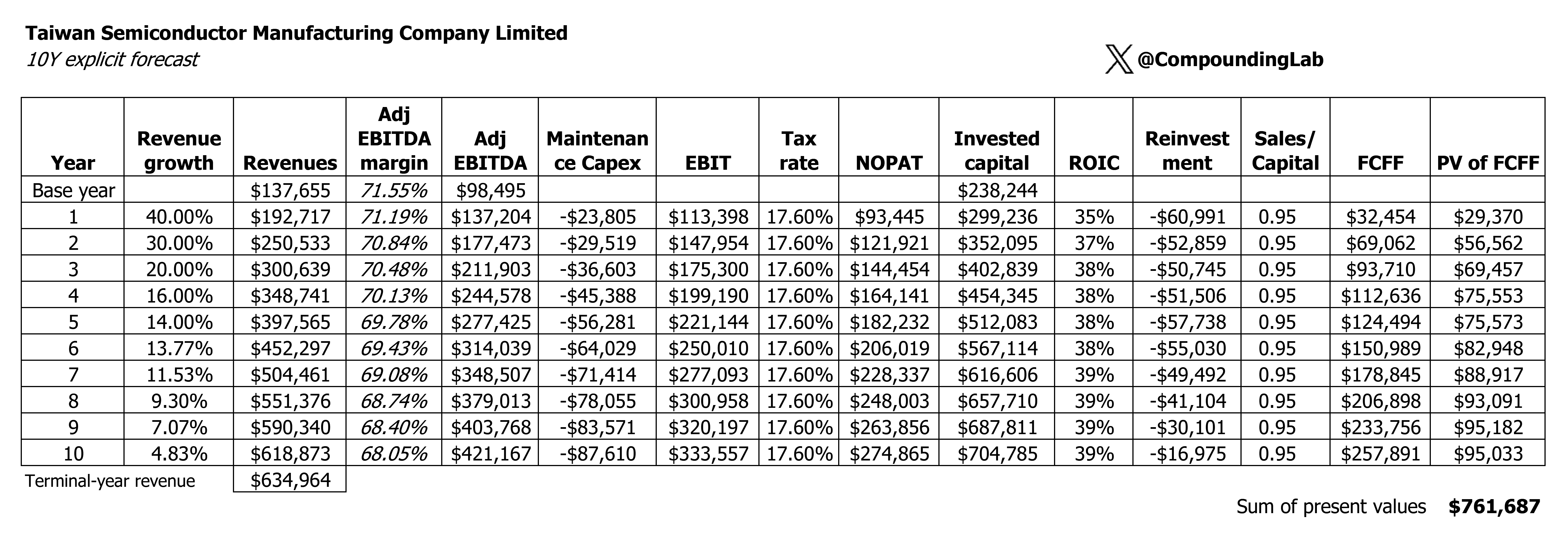
Historical and forward growth rate
TSMC has delivered an exceptional 18.6% revenue CAGR since its 1994 listing, with growth accelerating recently as demand for advanced process nodes and AI accelerators expanded; revenue increased from approximately US$45.5 billion in 2020 to US$122.4 billion in 2025, representing a five-year CAGR of about 22%. Looking forward, analysts expect close to 30-40%% US-dollar revenue growth in 2026 and management has raised its strategic outlook to a revenue CAGR approaching 25% between 2024 and 2029, driven by N3 and N2 adoption, advanced packaging and rapidly growing AI-accelerator demand. Beyond 2029, however, growth should gradually normalize as company becomes substantially larger, making a fade toward high-single-digit or low-double-digit growth by the mid-2030s a reasonable base-case assumption for a DCF.
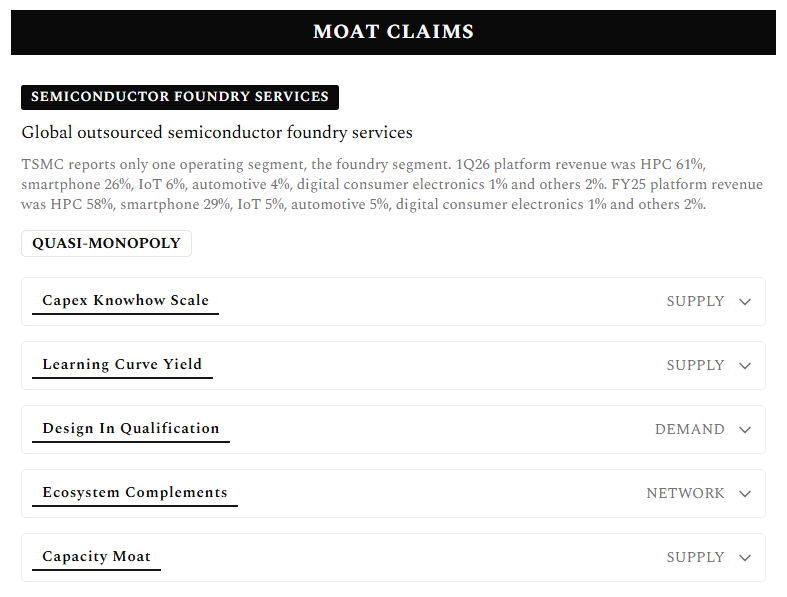
Moat
Taiwan Semiconductor possesses a wide moat supported by supply, demand, and network domains.
Verdict
CL intrinsic value for TSM is 436. Valuation suggests that the stock is trading at fair value.
Disclaimer: This post is for informational and educational purposes only. I do not own shares in TSM but can buy/sell them at any time after this post is published. Not financial advice. Do your own research.