$LULU DCF valuation model (updated)
I am revising LULU price target following recent company-specific challenges, amplified by a weaker consumer environment

Last time I shared my analysis on Lululemon back in March 2026, and I found that the stock was undervalued by 31%, with a target price of $239. Since the market tends to discount stock for a reason, I believe it’s a good opportunity to update my analysis and share the latest insights with you.
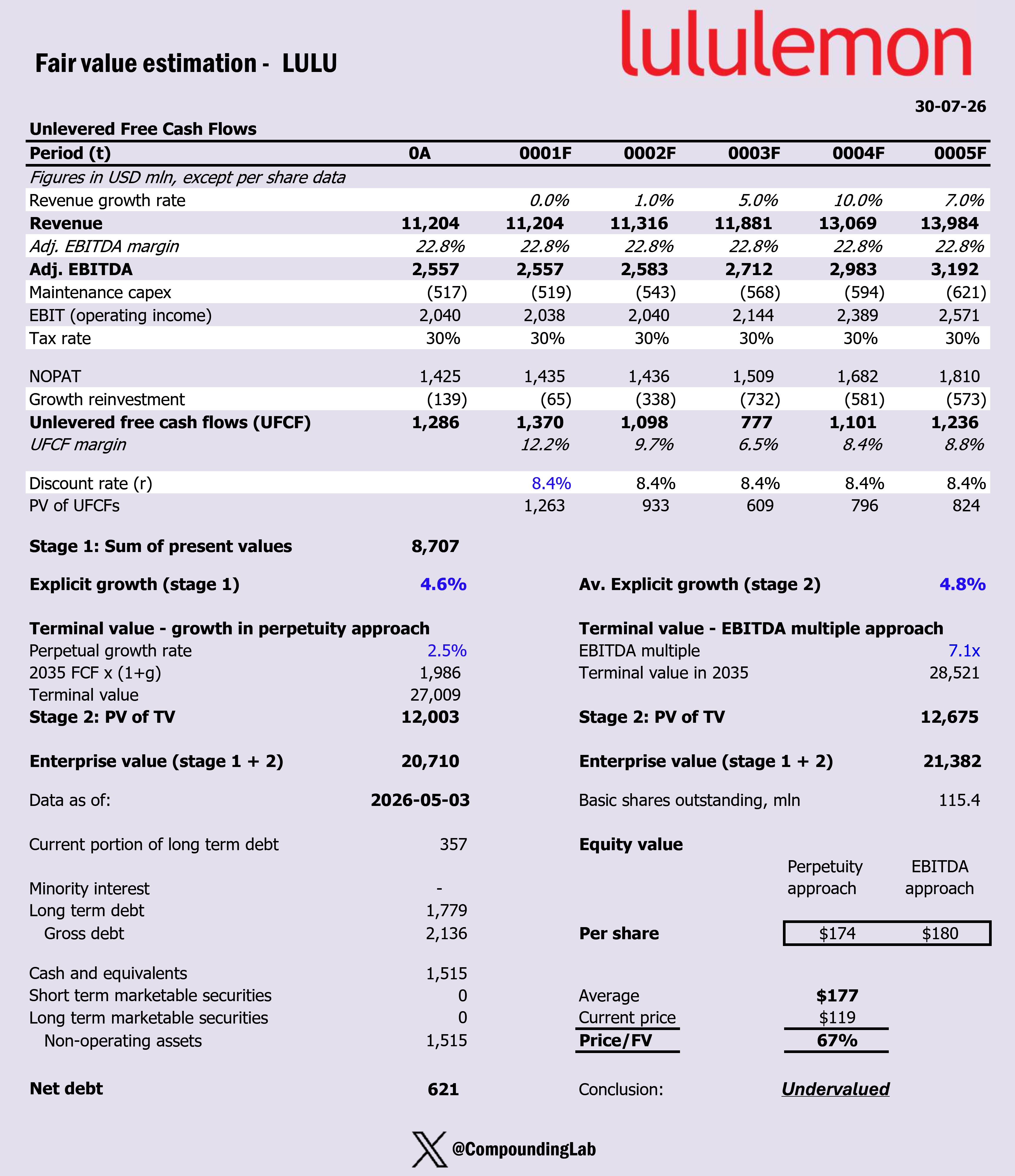
Key assumptions:
Explicit average growth @ 4.7%
Long-term growth in perpetuity @ 2.5%
Normalized EBITDA Margin 22.8%
WACC @ 8.4%
Adj. EBITDA exit multiple of 7.1
Tax rate 30% - in line with historical average
The input that drives reinvestment is the most recent Sales to Capital ratio = 1.72, linearly regressed to the Apparel average rate of 1.28 in year 10.
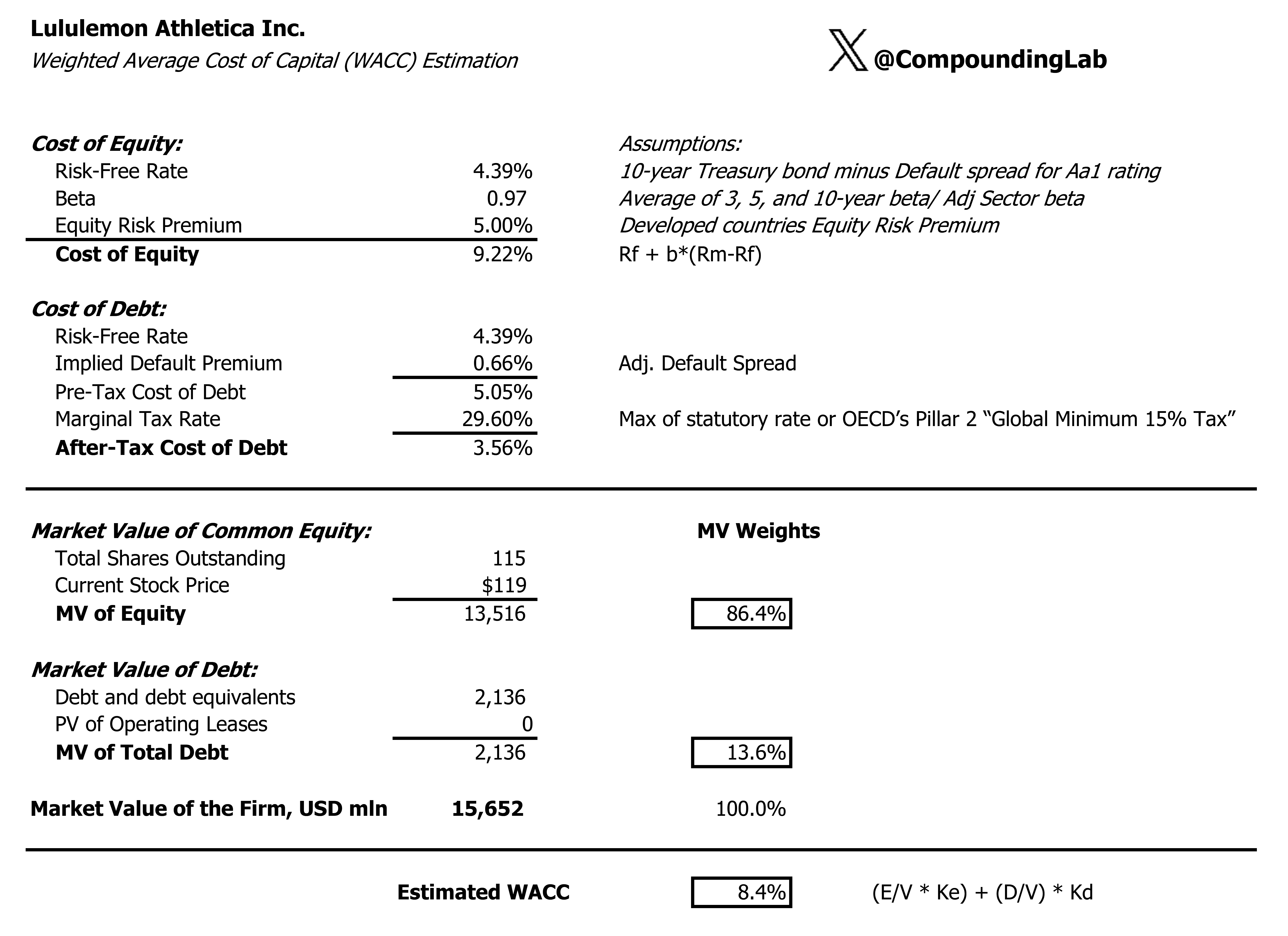
Historical and Forward growth rate
Lululemon’s historical revenue growth has been exceptional but is slowing sharply: sales increased from approximately $2.1 billion in FY2015 to $11.1 billion in FY2025, an impressive 18.3% ten-year CAGR. Annual growth decelerated from 42% in FY2021 to 30% in FY2022, 19% in FY2023, 10% in FY2024 and 5% in FY2025. For FY2026, management currently guides to revenue of $11.0–$11.15 billion, representing flat to a 1% decline, while analyst consensus expects approximately 3% growth in FY2027. For my DCF, a reasonable base case would assume a gradual recovery toward 4% annual revenue growth, supported by international expansion and before fading toward a 2.5% mature growth rate. Continued weakness in the Americas remains the principal downside risk.
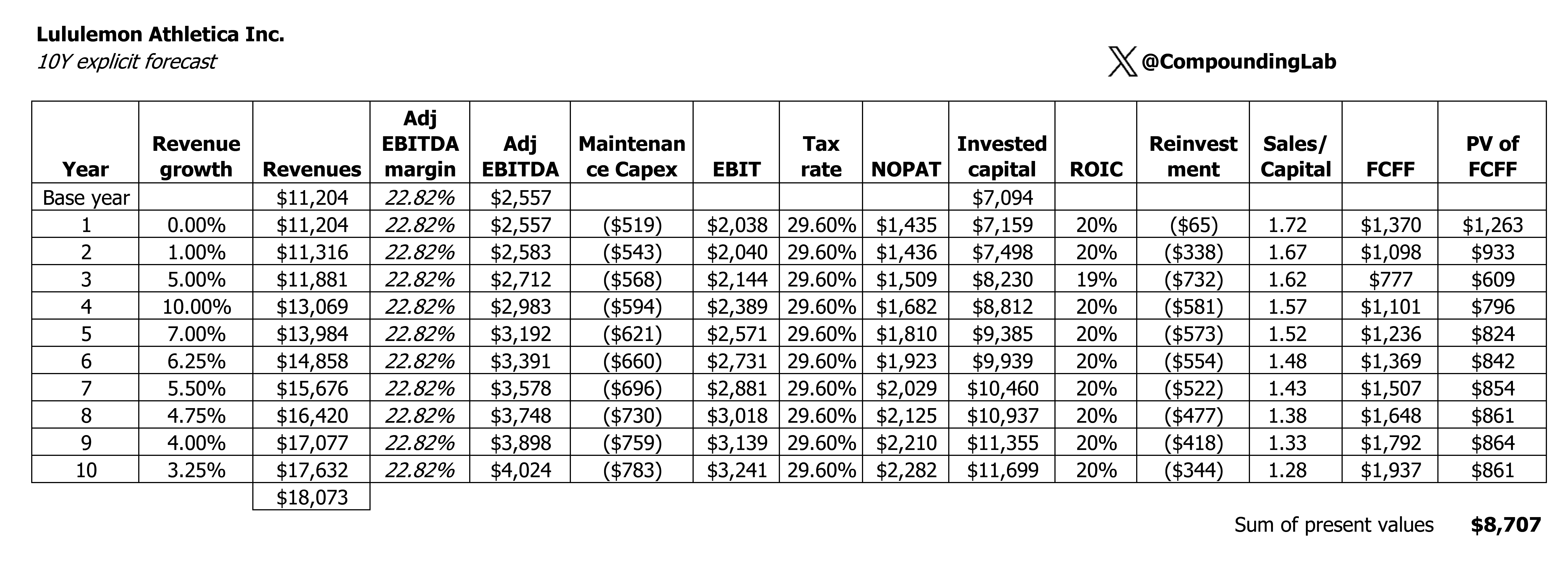
EBITDA to NOPAT bridge
Margin improvement over five to ten years is plausible as a turnaround assumption, but it is not presently reflected in consensus forecasts. For a base-case DCF, a 22.8% normalized EBITDA margin looks reasonable, as using anything higher would require a strong bull-case recovery.
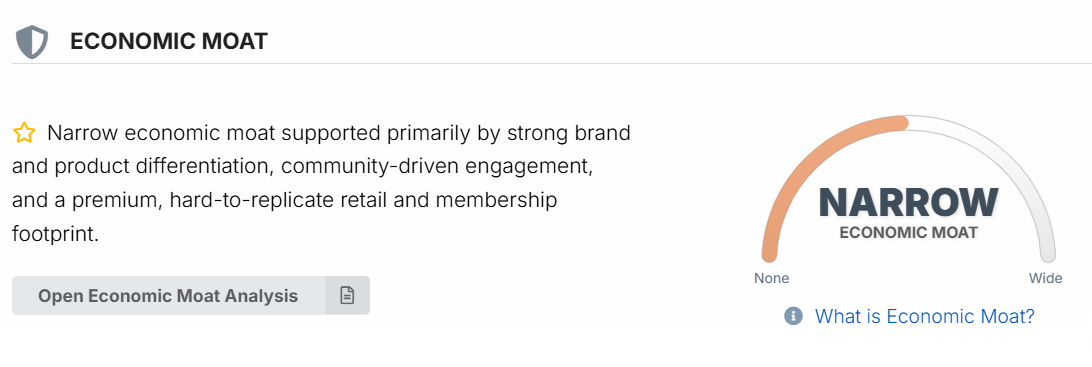
Moat
Despite challenges in apparel market, analysts generally assign narrow moat rating to Lululemon. My ROIC figure and terminal growth calculation reflect this.
Base case
CL price target for LULU is 172. Valuation suggests that the stock is trading at 33% discount to fair value. If adjusted to FV within 3 years, it will generate 14% in annual alpha.
Verdict
Hold. There is still an appealing discount in Lululemon stock. I have 1.5% of my portfolio in LULU, and I am not selling, but not buying more either.
Keep in mind that this is an estimate - just like any DCF model. I’m not claiming perfection, but I do trust these calculations to assist with my own investments. Hopefully, they can help inform yours as well. If you choose to share it online, please credit my page as the source. Look at it as a thinking tool, not necessarily as a stock-picking tool.
___________________________________
Disclaimer: This post is for informational and educational purposes only. I own shares in LULU and can buy/sell them at any time after this post is published. Not financial advice. Do your own research.
I appreciate your transparency. I think your growth rates are too optimistic though, especially the 10% growth in year 4. I also think your assumption of 20% ROIC is too optimistic as well - competition will compress this.
Personally, I think bear case is negative mid SD rev growth; base case is low SD (e.g. 1-3%) and bull case would be 4-5%. You could then to a probabilistic expected value calculation to get the fair value.